
 By Satyakam
 Hardee’s has been a familiar sight on many American highways and town centers for decades. The burger chain, known for its thick patties, breakfast biscuits, and loyal fan base, has one of the longest histories in U.S. fast food. But lately the brand has found itself in some serious legal trouble — not over food safety or ads, but over disputes with the very people who run many of its restaurants.
In late 2025, Hardee’s Restaurants LLC — part of CKE Restaurants Holdings, which also owns Carl’s Jr. — took a rare and public legal step. It filed a lawsuit against one of its largest franchisees, a company called ARC Burger LLC, demanding millions in unpaid fees and alleging a breach of contract. This lawsuit has rippled outward, leading to abrupt closures of dozens of restaurants and raising questions about the future of some Hardee’s locations across the U.S.
What Sparked the Lawsuit?
The lawsuit centers on money. According to the court filing, ARC Burger failed to pay more than $6.5 million owed under its franchise agreements. These fees included royalties, marketing contributions, and rent that franchisees are usually required to pay to the franchisor.
Franchise agreements are the backbone of how chains like Hardee’s grow. A franchisee pays upfront and ongoing fees in exchange for the right to operate restaurants under the brand’s name, use its recipes, and benefit from marketing and operational support. When those payments stop, franchisors often act quickly to protect their brand and business model.
Hardee’s claims that the unpaid fees have been accumulating since late 2024. It says ARC Burger repeatedly defaulted on its obligations but kept running the restaurants anyway. After months of back-and-forth, Hardee’s terminated the franchise and sublease agreements in September 2025. However, rather than close immediately, the franchisee continued operating under a temporary arrangement — one that quickly fell apart.
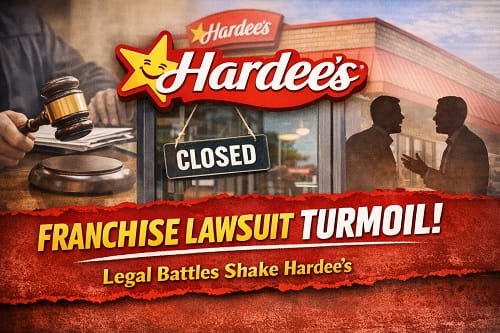
Restaurants Close Amid Legal Fight
The dispute quickly turned practical. In mid-December 2025, multiple Hardee’s locations owned by ARC Burger were forced to shut their doors, especially in the Midwest. Cities from Missouri to Kansas saw their local Hardee’s suddenly darken, with employees and customers alike caught off guard.
Many of these stores had only recently reopened under ARC Burger’s ownership after being bought out of bankruptcy by a previous operator. Now they face an uncertain fate, stuck in the middle of a legal battle between franchisor and franchisee.
A Hardee’s spokesperson tried to strike a balanced tone, saying the company understands the impact closures have on employees and communities. It also hinted at the possibility that some closed restaurants could reopen under new management or with different franchise partners.
Another Lawsuit in the Franchise Pool
The ARC Burger dispute isn’t the only lawsuit affecting Hardee’s. Earlier in 2025, another long-time franchisee — Paradigm Investment Group — sued Hardee’s over a separate conflict tied to franchise rules and operations.
In that case, Paradigm argued that Hardee’s was unfairly trying to enforce changes the franchisee said weren’t in its original contracts. These included requirements tied to technology fees, delivery systems, loyalty programs, and mandated operating hours — such as keeping restaurants open until late in the evening. Paradigm claimed some of these demands were added later through updates to internal manuals, not through the formal agreement it signed years ago.
Paradigm’s lawsuit seeks a declaratory judgment, an injunction to stop Hardee’s from terminating its franchise agreements, and compensatory damages — reportedly up to $35 million. A trial date was set for 2027.
These shifting legal fights illustrate a larger tension in franchise businesses: how much control a franchisor should have over individual restaurants versus how much autonomy franchisees can exercise while still keeping the brand consistent. In franchising, the rules around technology, hours, and fees aren’t just details — they can influence profitability and local customer strategy.
Why It Matters
For customers, these legal disputes may show up as locked doors, out-of-service menus, or empty dining rooms in familiar places. Hardee’s has thousands of locations across the United States, but the brand’s presence looks patchier now in markets like the Midwest, where closures have been most visible.
For the broader restaurant industry, the Hardee’s lawsuits are a reminder that franchise models — while powerful — can crumble when agreements break down. Rising costs, shifting customer behavior, and competition have squeezed many casual dining and fast-food brands in recent years. When you add complex contractual fights on top of those pressures, even long-standing names like Hardee’s can feel the strain.
As the legal cases move forward, both ARC Burger and Paradigm will continue to argue their sides in court. The outcomes may reshape how Hardee’s — and perhaps other franchise chains — handle payments, operational rules, and franchisee relations in the years ahead.

Satyakam Pradhan is a professional law content writer with extensive experience in creating clear, well-researched, and reader-friendly legal content. With a strong understanding of laws and legal procedures.